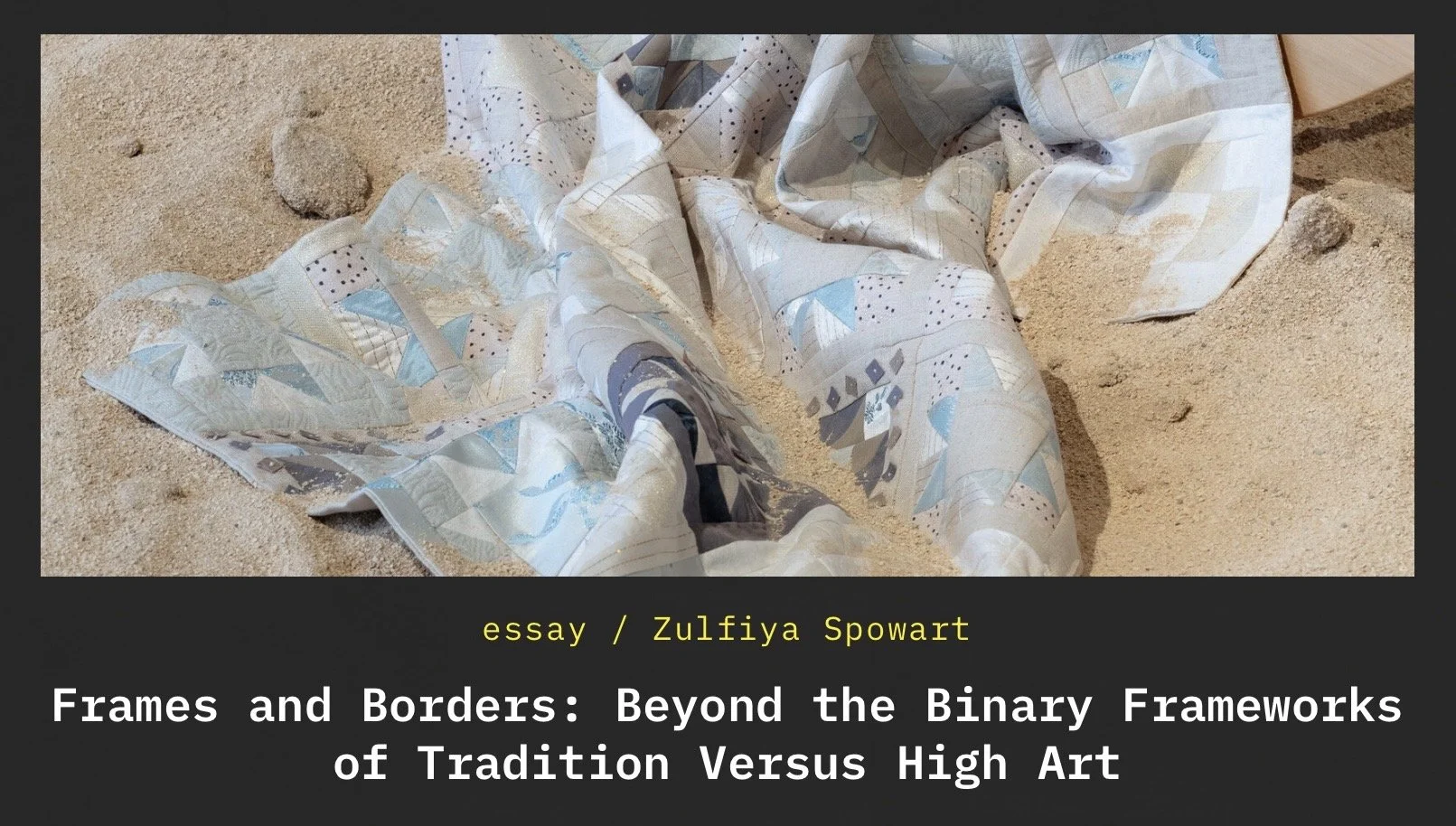
2026 - Frames and Borders: Beyond the Binary Frameworks of Tradition Versus High Art.
ODRA special publishing series exploring the evolving relationship between craft traditions and contemporary cultural practices in Central Asia. The aim is to amplify critical perspectives on how inherited knowledge, material practices, and collective memory are reinterpreted by artists, researchers, and cultural thinkers across the region.
Frames are constructed, and borders are blurred. My practice is grounded in a continual investigation of these thresholds: the moment I attempt to fix them, space loses its vital tension, the magic of life and love dissipates, and everything congeals into a cold, concrete cube. By “borders,” I do not mean lines on
a map, but a mode of perceiving reality — one in which embodied knowledge operates as a conduit between
the personal and the public. I position myself as a mediator: not in a pursuit of harmony or order, but in the destabilization of established roles and materials, at the point where familiar meanings fracture and become open to reconsideration.
The urban space of Tashkent serves as a key reference. It is one the world’s most eclectic cities, where Islamic architectural legacies intertwine with Soviet modernism, post-Soviet transformations, and the contemporary imagery of global gloss. While modernism privileges purity of form, local craft introduces rhythms of variation and unpredictability. Their intersection produces a nonlinear, stratified contemporaneity — shimmering and multiple, much like the identities of the region’s inhabitants.
My engagement with craft and architecture as two “bodies” of material memory leads to a central research question: how do the material practices of Central Asia generate their own forms of contemporaneity, beyond the binary frameworks of “tradition versus high art” or “heritage versus loss”? Craft does not become art through museum display alone, but through dialogue with bodies, spaces, and lived practices - when a craftswoman alters a pattern and becomes a co-author of urban form, or when residents adapt a modernist building and assume authorship over architecture.
When we speak about the culture of Central Asia - a region whose identity has been shaped for centuries through intersections, migrations, and the constant transformation of its own borders - it becomes impossible to perceive it through universal or fixed categories. In this context, the language of craft is not merely a decorative form or a mode of expression, but a form of material knowledge capable of remaining resilient through historical transformations. This knowledge existed beyond articulated systems, transmitted through the body, everyday gestures, repetition, and shared experience.
In examining this aspect, it is important to pay attention not only to visible changes in form, but also to the very mechanisms through which knowledge is transmitted: who was able to speak through this language, and who held the ability to preserve and transform it. Here we arrive at the question of what art is and who can be recognized as an artist within such a context. For me, the presence of overlooked voices is especially important. The influence of participants in everyday life often remains invisible, yet it is them who shape the living fabric of cultural space. In this sense, art is not created separately from life, but within it, continuously influencing the ways we exist, perceive, and interact with our environment.
Within my personal practice, I explore the interaction between textile and wood as carriers of familial and sensory memory. I learned to work with fabric by observing my mother sewing and embroidering, and this embodied knowledge is woven into my work. One of my early pieces is a tapestry in which delicate fields of color coexist with dark squares and ruffled elements.
Initially, I perceived the ruffles as a compositional failure; later, I came to understand them as traces of domestic craft — a bodily, intimate presence inseparable from artistic form. This shift revealed how cognitive constraints can limit our perception of matter’s fullness. When material returns to the body, it ceases to function as an archive — it becomes alive.
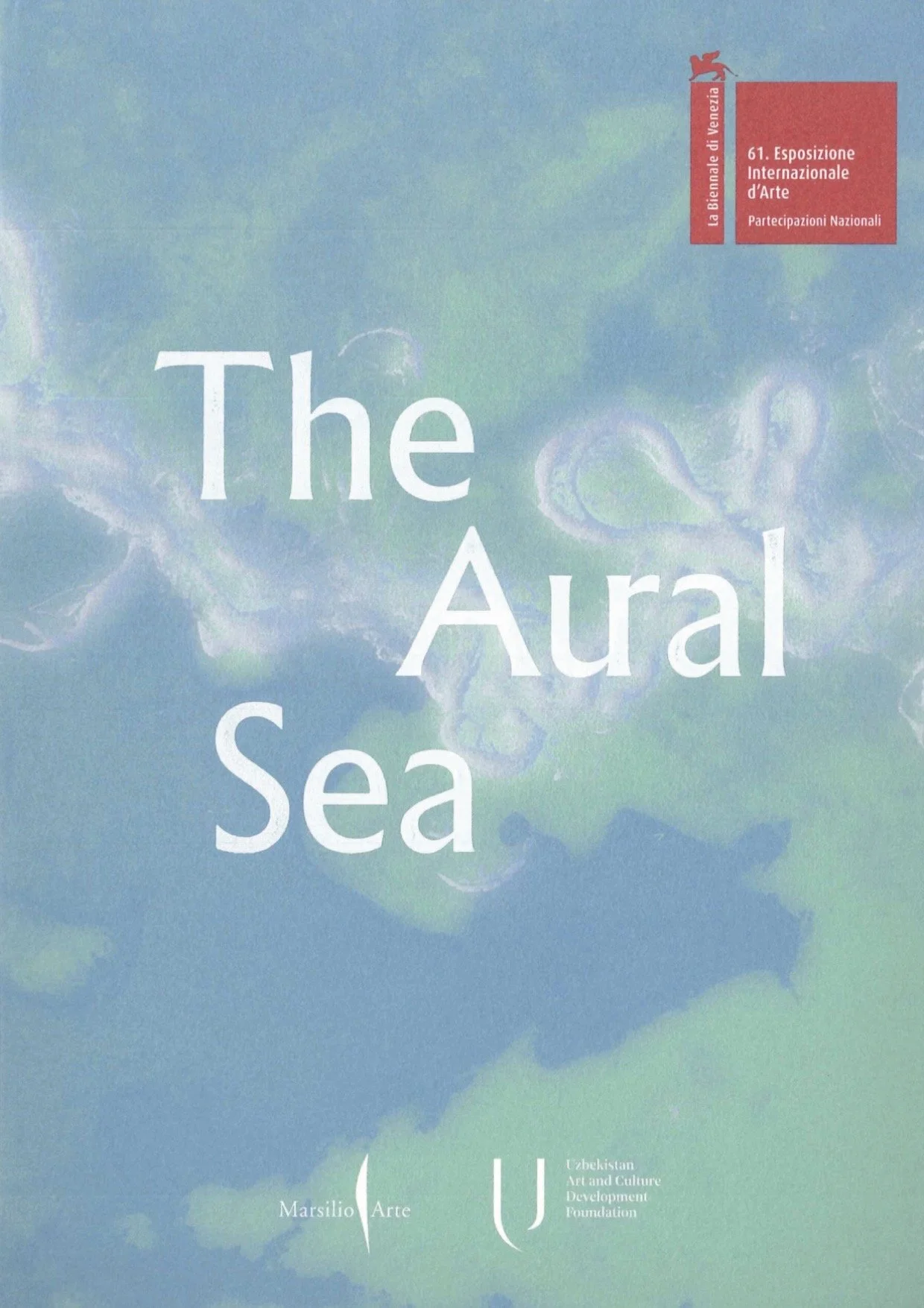
2026 - Artists in conversation with Aziza Izamova, curator of “The Aural Sea” group exhibition at The Uzbekistan National Pavilion at The 61st Venice Biennale of Arts for the Pavilion’s catalogue.
AI: Tell us a little about the origins of your practice?
ZS: I came to textiles in a very natural way. My mother had been sewing since she was a child, and in the Soviet era attended a cutting and sewing school where she learned to sew, knit and embroider. She did it all. As a child I loved altering clothes, going through my mum's old things and asking her to remake them for me.
Moving to London forced me to give up my studio, and painting became difficult with young children around. I started embroidering partly to keep my creative practice going. I could kneel on the floor and embroider while my child was sleeping. I could work in the playroom, in the living room or in between other chores. Eventually these experiments grew into a fully-fledged practice. Now I'm ready to adapt it to larger formats.
Working with wood also came about organically. My father used to make furniture at home, back in the 199os when it was much harder to get things. If we needed a crib, for example, he would simply go and make it himself. He made almost all the furniture in our house. Sometimes I would go to his garage to watch him work. I never studied it professionally - I absorbed it just by observing.
AI: Your textile works depict touching scenes, emphasising powerful subjects like the bond between mother and child. Where do you find inspiration?
ZS: I want to explore big, universal themes through small, intimate stories. My workplace isn't a professional studio; it's a domestic space. We create between eating and sleeping, and as such they become a part of you. Perhaps as a result, I find it's easier to tell a big story through personal narratives - it helps me to feel it more deeply. It's not only an intellectual reflection, but an experience you've processed through your own body and life.
AI: What inspires you artistically?
ZS: Georgia O'Keeffe is one important reference, particularly her works from the period when she moved to Taos in New Mexico. I love how the environment is reflected in her work. She lived in New York for a time and painted skyscrapers, which men told her wasn't a very "ladylike" subject. Later she would look at the canyons of the American west and talk of infinity, of the existential nature of life and death. She would find the skulls of horned cattle, skeletons, bones. Many commentators have tried to reduce this interest to "feminine" symbolism. But she would deny it and say she was simply looking into space.
Those bones were a part of the landscape. It's not at all macabre, not about death. It feels very natural, even gentle and bright. I love the naturalness in how she speaks about life and death. For example, elements similar to horns appear on a cot I'm making. At first, they were completely accidental, but maybe all of this was on my mind. When I was reviewing the material for the project I realised it all connects: the canyons, arid landscapes. Things return to the soil and the subsequent fertility of the earth depends on what goes into it.
In this sense wood is special too. When you look at a cross-section of wood, it resembles the cross-section of a body — either an animal's or a human's — we just don't perceive what we're seeing as gruesome. A cadaver is also a severed trunk, a cut material, but we relate to it differently. Of course, I don't go and chop down a tree for the sake of making art. I take what has already been felled. This raises a question for me: if we speak more broadly about colonisation, about the past, by definition it has already taken place. One can argue, certainly, and condemn, even try to go back. For some people these are important processes. But I think more about what we have today. And the question becomes about what we will work with from here. It's the same with the cross-section of wood: it already exists. But with what has already been made or done, you can create something new. That's the kind of relationship I have with wood.
AI: Drawing attention to this is part of this project.
ZS: Reality is never black and white. We always have to make choices, even When it seems impossible. When we think we can achieve anything, that's an illusion. In reality we adapt somehow and find our own way forward. Nature as a whole —animals, all living creatures — adapt in a way that feels natural, innate, almost divine, without conscious control. They are always focused on survival. It's the same way we focus on protecting a baby's life. A mother develops almost supernatural powers. When I look back and think about the time when my daughter was younger, I think: how did I even manage? Now I look at any mother and think: how is that possible? It's as if something inside you switches on that just naturally helps you cope. The same goes for people who find themselves in extreme conditions. Sometimes they survive, and you think: how did that happen? This ability to adapt is very strong.
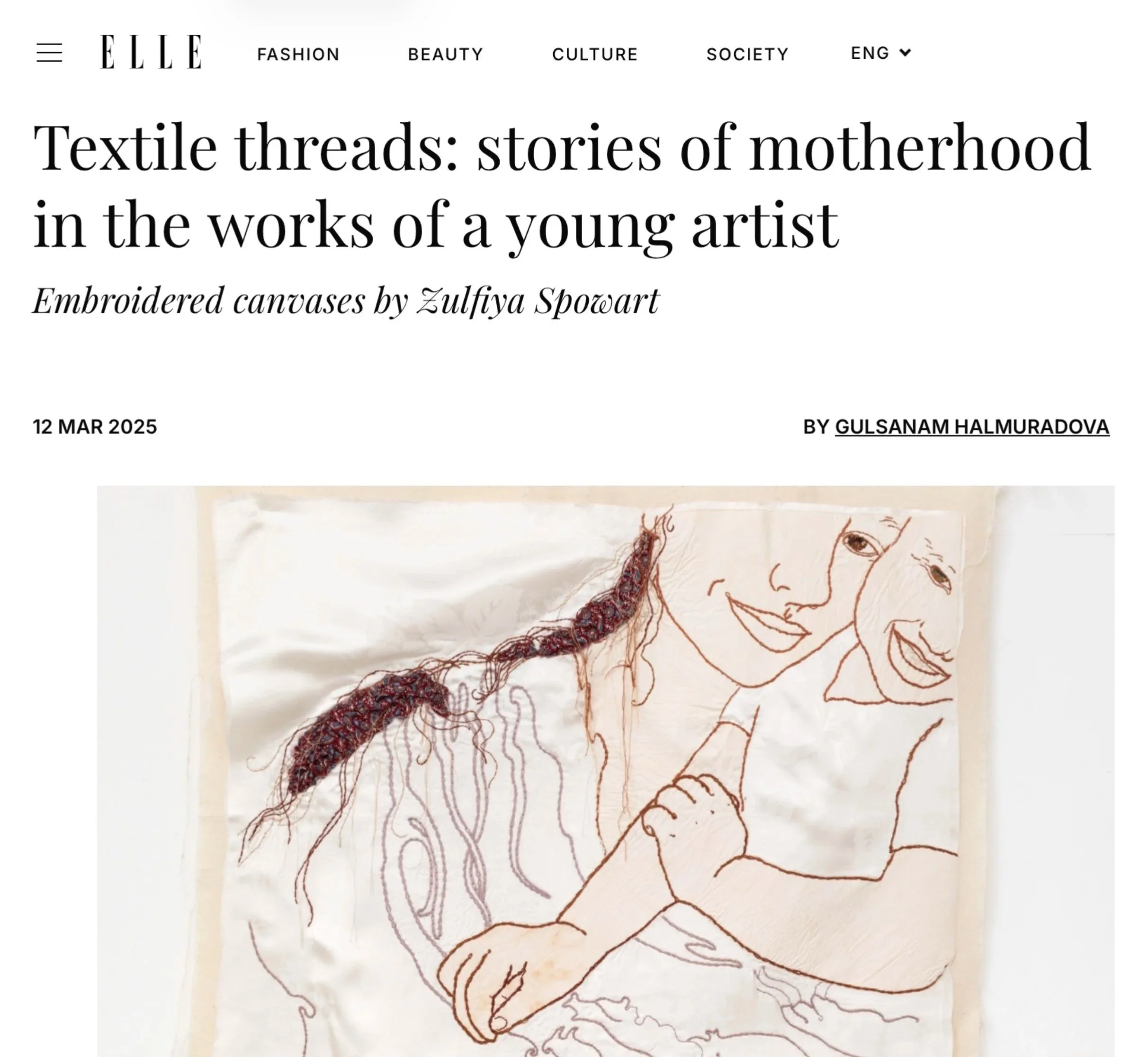
2025 - Interview with Gulsanam Halmuradova for ELLE Uzbekistan.
GH: What does decolonization mean to you in the context of your art?
ZS: Since my work is deeply connected to questions of identity, decolonization is more of an optical shift – a way of looking inward. It is a first-person dialogue, where I constantly question the imposed perception of reality. I aim to trace the deepest roots of specific perspectives and reinterpret them, choosing my own direction.
GH: Are there any historical or cultural events that have influenced your work?
ZS: I was born five days after Uzbekistan declared independence. In the first year of my life, my parents found themselves navigating the liminality between two cultures, suddenly immersed in a post-colonial world. I absorbed this sense of in-betweenness, though I never fully understood its roots. Now, I realize that my personal development coincided with the formation of a new social order, shaping a threshold perception of reality. This intermediate state is precisely what I try to capture in my work. Reflecting on my mother’s experience caught in cultural displacement, she sewed, knitted, and embroidered clothes and toys for me and my brother while simultaneously adapting to a new life. Now, as an immigrant mother myself, I feel a similar experience—raising three daughters while adjusting to the difference between past and present.
GH: What do you hope to convey about motherhood through your work?
ZS: Above all, I want to capture not just the inexpressible love of a mother, but also the physical closeness of a child’s small body. The fleeting nature of this period, the fragility of life, and our vulnerability. These emotions are most vividly reflected in children. For this series, my daughters were an integral part of the creative process – both as models and as part of the embroidery practice, which took place while caring for them. It is also important to establish femininity, motherhood, and childhood as essential themes in art, allowing us to tell these stories through personal experience. This is a rejection of patriarchal narratives – a statement of existence.
GH: What materials and techniques do you use to express these themes?
ZS: The material found me naturally. Previously, I worked on large-scale canvases, but with small children, that became impossible. At the same time, I didn’t want to separate myself from my children to create, nor did I want to pause my artistic practice. I tried embroidery, and textiles opened up a new world for me. It is an incredibly tactile and warm medium, and since I inherited these skills from my mother, it feels like the fabric embraces imperfections the way a mother accepts her child. Through this trust in dialogue with the material, spontaneity emerges – something I could never achieve in painting.
GH: How do you use color and form to express maternal experiences?
ZS: I choose color and form intuitively. In this series, I worked with photographs where unusual selfie angles create a sense of subjectivity rather than mere observation. I also convey the themes of transition and cultural heritage through folk motifs and compositions. With color, I wanted to evoke purity and tenderness while also reflecting the cultural imprint on the human body. The choice of fabric was also deliberate – natural dyeing with organic materials, creating soft, uneven tones, alongside vintage textiles from the Chorsu Bazaar, originally produced in the 1960s–70s (my mother lovingly selected these fabrics and brought them to me).